I’d like to think of myself as an intelligent, insightful resource for all things photographic, especially classic manual-focus film cameras. I’d like to think that, so please don’t disturb my fantasies. In the meantime, if you really are into that intelligent, insightful stuff, I recommend you visit James Tocchio’s Casual Photophile. He’s primarily responsible for my acquisition of a Minolta CLE (sorry, I didn’t buy it from your on-line store, F Stop Cameras, but you did sell me an MD Rokkor-X 45mm that is perfect for my Minolta XG-M – which means I have to agonize over which camera gets the next roll of Tri-X – damn you James Tocchio!). He does this very cool live-stream take-apart-a-camera piece by piece by piece, but I can’t seem to keep track of the schedule (is there a schedule?). Recent articles have included one on the Voightlander Bessa R and another on the Minolta XD (or XD11 in the United States) (as Mike Krukow would say, “IwannagetthatIwannagetthatIwannagetthat!”). James and his stable of writers understand the joys of shooting manual, shooting film, and shooting classic. Check them out.
A far more detailed account than the movie Finding Vivian Maier, Pamela Bannos’s book debunks some of the popular myths that have grown around this posthumous celebrity. Foremost among these is the idea that Maier was a nanny who took pictures – Bannos sees her as a photographer who conveniently supported herself as a nanny. Maier’s secretive, elusive mystique – while undoubtedly partially fueling her “success” (original prints selling for up to $10,000) – is replaced by extensive details of her life, including her early years in New York and Chicago, with forays to Los Angeles, San Francisco, and Vancouver, and a trip around the world. For classic camera geeks there is information about her Leicas and Rolleiflexes, as well as perspective on her place in the history of street photography. Bannos addresses the still murky arena of Maier’s copywrite protection and, without really taking sides, whether it is ethical or even legal for others to be making money off of her art. The author, a professor of photography at Northwestern University, does not pull punches on her opinion of John Maloof’s Finding movie (nominated for an Academy Award), which she finds full of omissions and distortions. Vivian Maier: A Photographer’s Life and Afterlife is a compelling tale of a unique photographic talent and is highly recommended. Five out of five f-stops.
Every good photograph has a story behind it. Some cameras come with a tale, too. Here’s one.
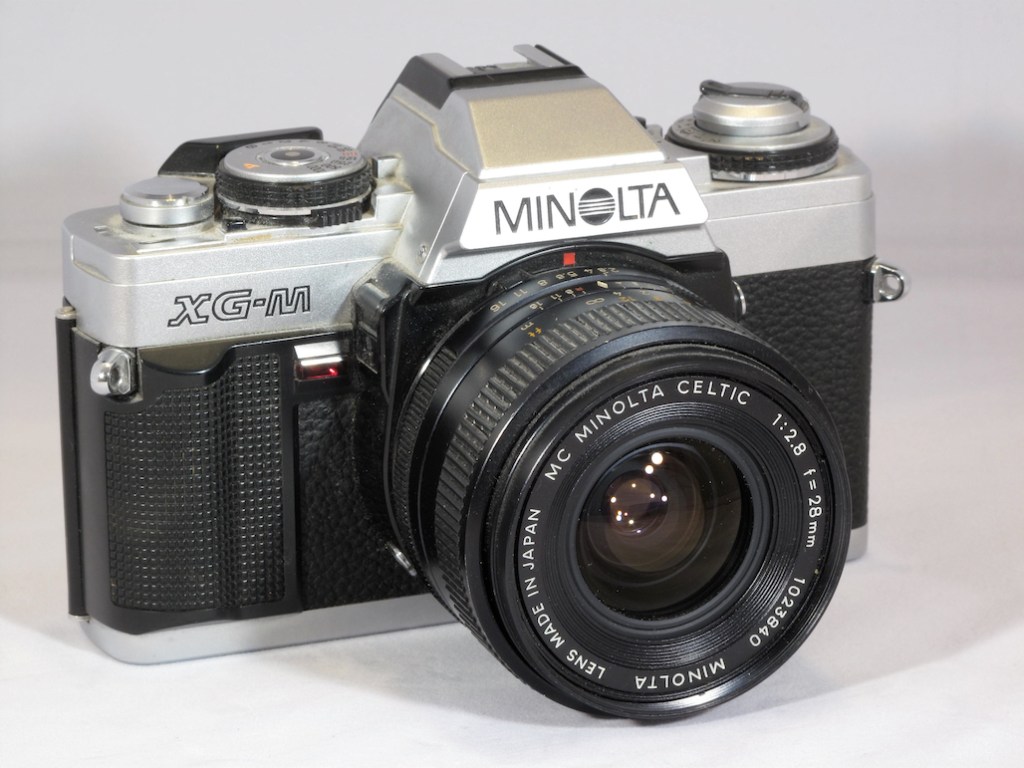
My most recent new old camera is a Minolta XG-M. I bought one of these new in 1981. It’s easy for me to date the purchase because the first photo I took with it is of my son in his stroller, looking about three months old or so (he was born in November of 1980). I don’t remember exactly why I bought the XG-M, other than to “upgrade” from a perfectly serviceable Minolta SRT-101 from 1968 (remember, in those days a camera’s life was measured in decades, not the years – or even months – that we have now). Maybe it was the more compact size, or the electronics (aperture priority was a big new thing), but certainly the choice was dictated by my capture within the Minolta ecosystem – the ability to continue to use SR-mount lenses (exactly the same dynamic that now keeps a photographer with Nikon or Canon).
The camera worked perfectly until it died in 1987. I’m sure it could have been repaired, but that era marked the emergence of autofocus, and I had already noticed that maintaining accurate focus on moving kids, especially playing soccer or baseball, was a challenge. Camera life now being measured in less-than-decades, it was time to upgrade again, and since there was no backward compatibility for lenses with the new autofocus mounts, I decided to go with the sleek, curvy Canon EOS rather than the clunky, angular Minolta Maxxum. The same market forces that had originally kept me with Minolta now locked me into Canon for the next couple of cameras.
35mm was pretty much set aside when I discovered the wonders of medium- and large-format, and later the convenience of digital. The Minoltas and Canons became the genesis of my camera collection. But several years ago I reached back and found (or remembered) that the grain of 35mm Tri-X had an enticing look that was different (not better or worse) than the smooth tonality of the larger negatives. I acquired a Minolta CLE, a rangefinder with a Leica lens mount – completely incompatible with my other Minolta lenses – and found it a joy to shoot. And then, on a whim, I perused the film cameras on eBay, and jumping right out at me was a pristine XG-M body for $22, including shipping. Those 50-year old lenses could have a new lease on life. I grabbed it.
I’m still working through my first roll with this camera. Everything feels and sounds right, so I’m sure I will be pleased with the results. I have to wonder, though, if the first XG-M hadn’t malfunctioned, would I have still moved to Canon, and how would that have affected my discovery of Fuji rangefinders and the Sinar F1 or even digital? If I hadn’t stoped using my earlier cameras would I have had the opportunity to rediscover 35mm with the CLE? I certainly wouldn’t be purchasing an XG-M if the first one was still working.
The final irony of this saga is the $25 Gordy’s wrist strap on my $22 camera.