Book review.
Shooting Film: Everything You Need to Know About Analogue Photography, by Ben Hawkins (2022)
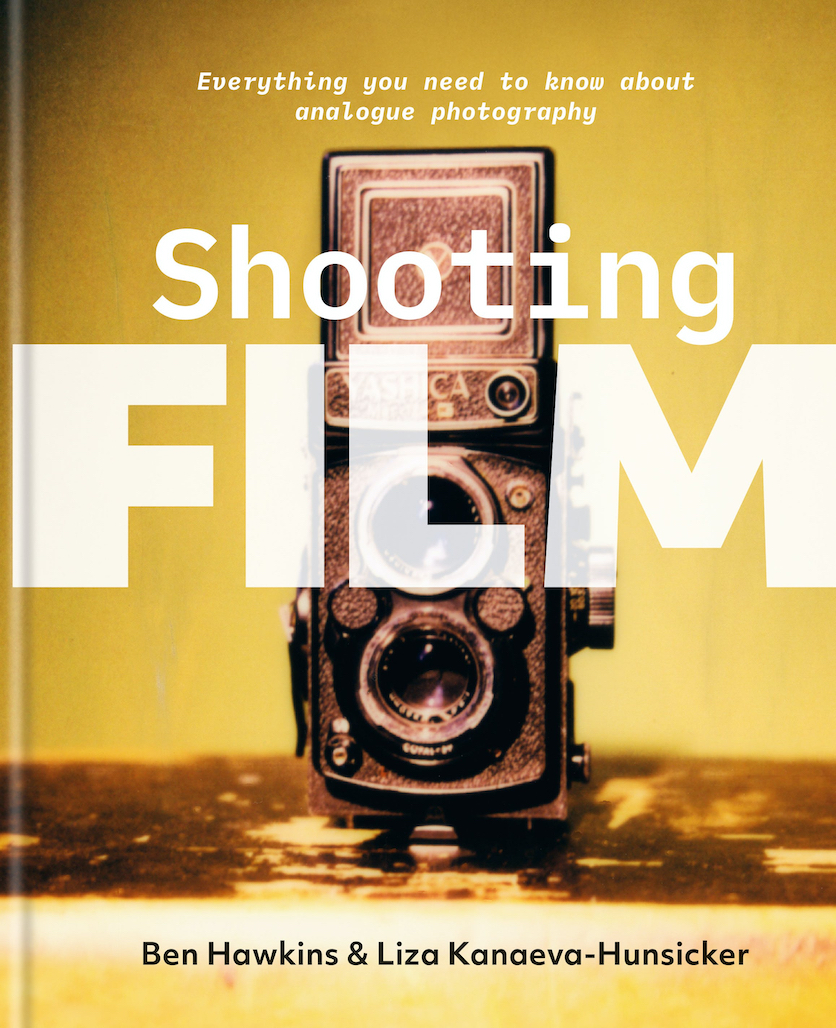
This sounded like a fun diversion for me – a new book about film photography written, apparently, for younger people who have discovered film as a new . . . diversion? Maybe it would remind me of some finer points that I have overlooked, but more likely just confirm what I already know. I was not expecting so many curious choices, partial or inadequate explanations, and outright errors – nothing that would ruin someone’s photography, but enough to suggest that the book needed amore attentive editor. To wit . . .
- Am I the only person annoyed by “analogue”? How about “film”?
- The cover photo is out-of-focus and off-color. This is apparently a nod to Lomography, the embrace of, well, out-of-focus and off-color. Must be a generational thing.
- On page 19 the author implies that Leica only makes digital cameras (but on page 44 he makes it clear that they also still make film cameras).
- Page 20 – A Canon AE-1 Program is labeled as a Canon AE-1.
- Page 25 – No, on most large format cameras the dark slide does not take the place of a shutter.
- Page 35 – No, the Minolta X-700 was not the last Minolta manual focus camera (maybe he meant the last major Minolta manual focus camera). The X-700 was introduced in 1981, the X370s in 1995.
- Page 38 – Maybe this is an Englishism – what he calls back-to-front I would call left-to-right (talking about a TLR viewfinder).
- Page 45 – No, the Minolta CLE was not made in collaboration with Leica. The earlier CL was, but by the time of the CLE the two companies had ended their partnership.
- Page 56 – This is a really bad look – holding a negative with a thumb planted in the surface. The author should read his own book – on page 158 he cautions to only handle negatives by the edges.
- Page 70 – Titanium scissors? I’ve cut negatives for over half a century with any available pair of scissors – never a problem.
- Page 102 – No, for Sunny 16 its the reciprocal of the film speed, not the film speed.
- Page 118 – Advice to permanently leave a UV filter on your lens omits the possible downsides, image degradation and increased flare.
- Page 118 – This is very much my opinion, but I would say that if you have one black & white filter it should be orange. Yellow doesn’t make enough difference to make a difference.
- Page 132 – Creative light flaws – no thanks.
- Page 142 – “Deving” for “developing”? Is that how the kids talk these days?
- Page 143 – The author failed to mention that the reel that comes with the Paterson Super System 4 is inferior to third-party reels with a larger lip.
- Page 143 – No, film drying clips are expensive photo-specific pieces of equipment that can be replaced by much cheaper bulldog clips from an office supply store.
- Page 146 – The author fails to mention that an enlarger is incomplete without a lens, which is typically a separate purchase and may have more influence on print quality than the enlarger.
- Page 148 – It is not necessary to leave a small border around the print. There are borderless easels that work just fine, a drying rack is more efficient than hanging prints (at least for RC paper, which most beginners would be using), and prints can be handled by the edges or with cotton gloves to avoid fingerprints.
- Page 149 – The author fails to mention the dry-down effect. That first print may turn out to be a disappointment.
- Page 189 – The author fails to distinguish between match-needle metering and truly manual control.
- The author recommends a 50mm lens for portraits. Something in the 80mm range would be better (we’re talking 35mm cameras here).
- And finally, the input from several photographers, particularly Liza Kanaeva-Hunsicker, was not helpful. Most of the photographs were unappealing.
A list of what the author got right would obviously be longer than this error list. I give the book two f-stops (out of five), mostly for the good intentions.
 Tom Raymondson Photography
Leave a comment