The story of my newest old camera.
Every good photograph has a story behind it. Some cameras come with a tale, too. Here’s one.
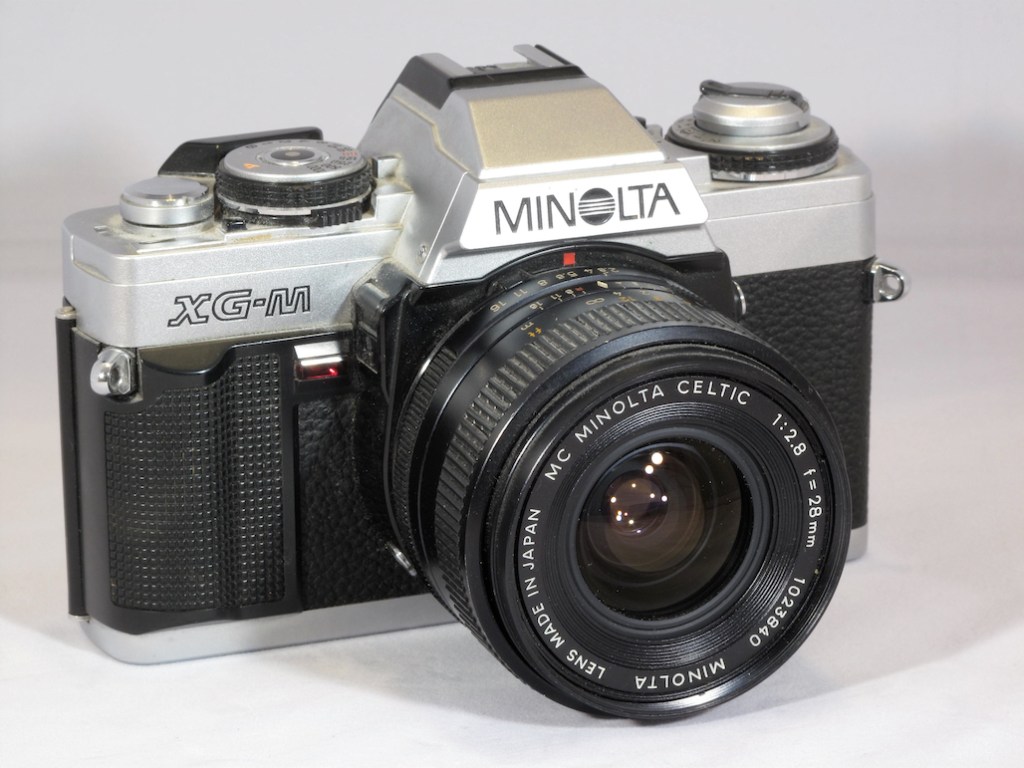
My most recent new old camera is a Minolta XG-M. I bought one of these new in 1981. It’s easy for me to date the purchase because the first photo I took with it is of my son in his stroller, looking about three months old or so (he was born in November of 1980). I don’t remember exactly why I bought the XG-M, other than to “upgrade” from a perfectly serviceable Minolta SRT-101 from 1968 (remember, in those days a camera’s life was measured in decades, not the years – or even months – that we have now). Maybe it was the more compact size, or the electronics (aperture priority was a big new thing), but certainly the choice was dictated by my capture within the Minolta ecosystem – the ability to continue to use SR-mount lenses (exactly the same dynamic that now keeps a photographer with Nikon or Canon).
The camera worked perfectly until it died in 1987. I’m sure it could have been repaired, but that era marked the emergence of autofocus, and I had already noticed that maintaining accurate focus on moving kids, especially playing soccer or baseball, was a challenge. Camera life now being measured in less-than-decades, it was time to upgrade again, and since there was no backward compatibility for lenses with the new autofocus mounts, I decided to go with the sleek, curvy Canon EOS rather than the clunky, angular Minolta Maxxum. The same market forces that had originally kept me with Minolta now locked me into Canon for the next couple of cameras.
35mm was pretty much set aside when I discovered the wonders of medium- and large-format, and later the convenience of digital. The Minoltas and Canons became the genesis of my camera collection. But several years ago I reached back and found (or remembered) that the grain of 35mm Tri-X had an enticing look that was different (not better or worse) than the smooth tonality of the larger negatives. I acquired a Minolta CLE, a rangefinder with a Leica lens mount – completely incompatible with my other Minolta lenses – and found it a joy to shoot. And then, on a whim, I perused the film cameras on eBay, and jumping right out at me was a pristine XG-M body for $22, including shipping. Those 50-year old lenses could have a new lease on life. I grabbed it.
I’m still working through my first roll with this camera. Everything feels and sounds right, so I’m sure I will be pleased with the results. I have to wonder, though, if the first XG-M hadn’t malfunctioned, would I have still moved to Canon, and how would that have affected my discovery of Fuji rangefinders and the Sinar F1 or even digital? If I hadn’t stoped using my earlier cameras would I have had the opportunity to rediscover 35mm with the CLE? I certainly wouldn’t be purchasing an XG-M if the first one was still working.
The final irony of this saga is the $25 Gordy’s wrist strap on my $22 camera.
 Tom Raymondson Photography
Leave a comment